
Your shop's pricing, decoded and running.
We pull the estimating rules out of your spreadsheets, your history and your legacy system, and put them in software your people can audit. Every quote prices on your presses, your paper and your rates. One record carries it from the customer's email to the invoice.
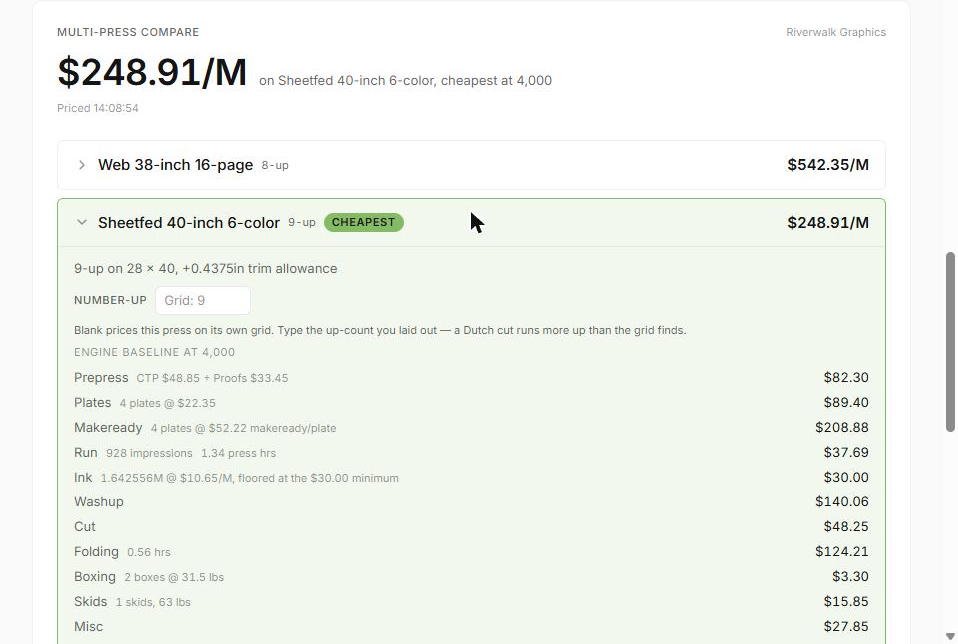
Every quote you have ever written, read back to you in plain language.
You know what you quoted. Whether you won it, why you lost it, and whether it was worth chasing are usually somebody's impression. Intel reads the whole quote history, finds what stands out, and writes it up the way an analyst would, with a short list of things to try.
So the answer is not to stop quoting them. Inside those accounts, short runs win 2% and mid-size runs win 2%, while long runs win 32%. The read tells the shop to quote the short and mid work lean and spend its estimating time on the long runs.
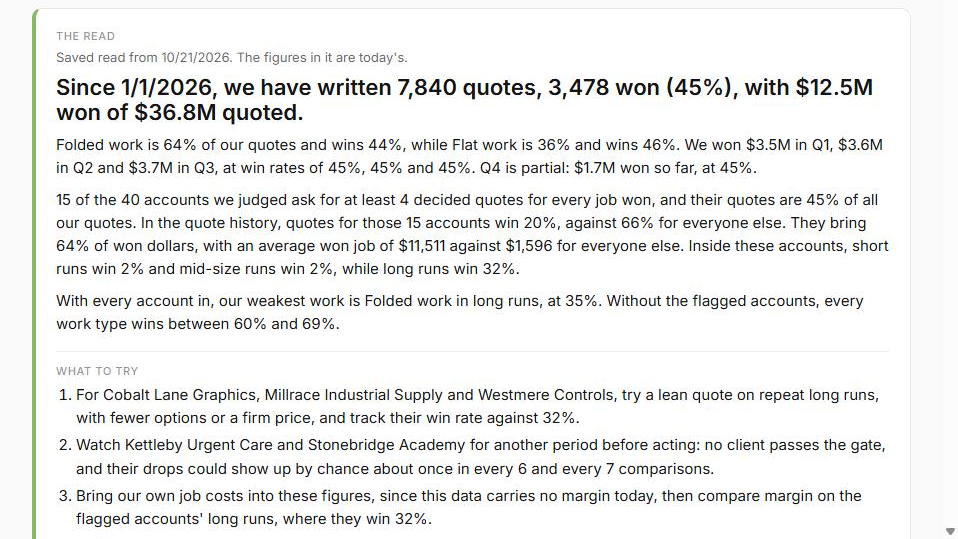
The demo shop's own data. In the demo, the read is saved and the figures in it are today's.
Folded work in long runs looks like the leak. It is not.
Counted across every account, folded work in long runs wins 35%, the weakest cell in the shop. Take out the 15 accounts that shop every job, and every work type wins between 60% and 69%. The shoppers send most of the long folded quotes, so they were dragging that cell down. Intel separates them before it calls anything a leak.
Open any account and it tells you what it sees.
For one brewery in the demo shop, the shop wins 72% of quotes that go out within a working day and 18% of the ones that take four or more. Had the slow quotes won at the fast rate, about 19 more jobs would have come in. Every figure is calculated from the quote history, and the read says plainly what it cannot tell.
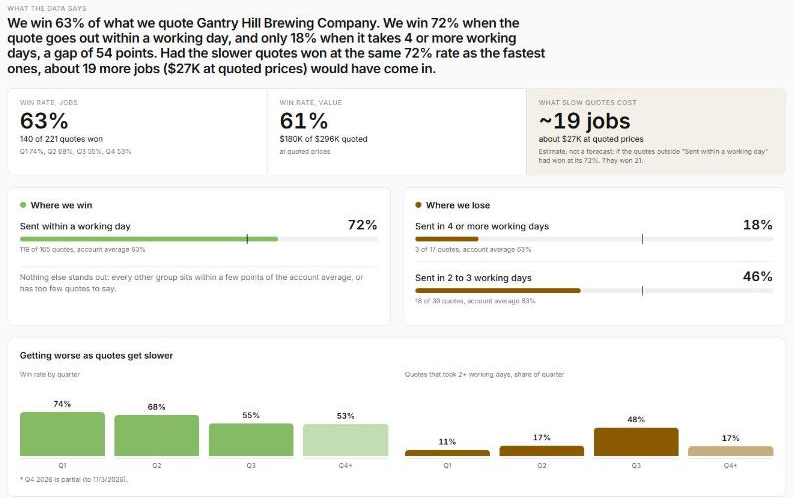
The demo shop's own data.
The model never types a number.
A wrong figure cannot reach the screen, because the model never writes one. It is also told to say so when the data cannot answer the question.
Win rates, dollars, gaps and trends come from your quote history, calculated by ordinary software, and nowhere else.
It writes the analysis around placeholders that point at those figures. Observations, hedged explanations and things to try.
Any digit, number word or claim the figures do not support is thrown out. Only then does the software fill in the real values.
When there is nothing to report, Intel says so. Nobody past their usual reorder gap. No difference between your quote writers. A client moving but not yet proven. An honest empty state is part of the product.
Approved work lands on the press schedule.
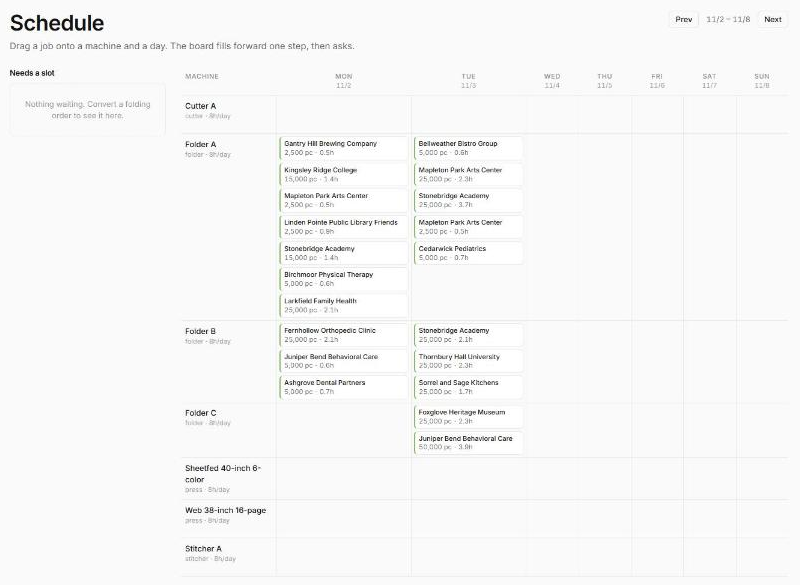
Every job sits on its machine and its day, with the hours it will take. Drag a job to a different press or day and the board fills forward one step, then asks.
- Win rate by customer and by channel: broker, broker network, direct, mailer, trade printer.
- Dollars quoted against dollars won, counted at the price you quoted.
- Dollars per press hour, so you can see which work is worth the floor time.
- Which accounts are growing and which have quietly stopped calling.
- Paper on hand, on order, committed to live orders, and merely spoken for by estimates.
- The last three jobs like this one, on screen while you price: date, price, size, stock, colors, won or lost.
- What this customer has said yes to, and at what number.
- Where the price actually went: press, forms, plates, makeready, paper, cutter.
- A follow-up clock, so a live quote never ages out at the bottom of the pile.
- A layout you can check, and change, before it goes out.
Historical quotes reproduced to the cent, using zero fitted constants.
Pieces on a live job where the system matched the estimator's own spreadsheet to the penny, at $6.66 per thousand.
Found on one 8-version web job, by imposing the versions onto forms better than the hand layout did.
The demo is the same test. Send 10 quotes you wrote last year. We price them and compare line by line, in front of you.
We have been quoting the same way since 1987.
A spreadsheet one person built. A price out of somebody's memory. The job retyped four times between the quote and the invoice, and no record of what you won, what you lost, or why.
The estimator who holds it all together is 5 years from retiring, and none of it is written down.
It prices the job on every press that can run it.
Presses that cannot hold the roll or the basis weight drop out of the compare. For versioned work it imposes the versions onto forms, prices every form count, and takes the one that costs least. Then it tells you when that layout overprints more paper than your rule allows, so the call stays yours.
A real 8-version job, 4-up on a heatset web. 451,667 sheets across 4 forms. The estimator's hand layout ran 460,000 and the shop's old system ran 475,000. The difference is about $1,000 on one quote.
What does a quote cost you, and what does a win cost you?
Every shop knows its cost per thousand impressions. Almost none of them know what it costs to produce a quote, or how much of that cost is carried by the orders that actually land. Put your own numbers in.
Move the win rate 3 points, from to , and that last number drops to per order on the same spend.
Hours and pay rates are estimates you control. The point is the shape of it. A quote that loses consumed a real hour of a real person, produced nothing, and was never counted as scrap. The shop measures spoilage on the press to the sheet and measures nothing at the quote desk.
Your presses, your stock, your cost structure.
Every number the shop prices on lives on a card you control. Nothing is a model's opinion, and nothing is a constant buried in code.
Press and makeready rates
Hourly rates, run speeds, makeready hours per added form, waste ladders, roll widths and basis limits, per press.
Paper and ink
Buy and sell by hundredweight or by skid, ink coverage by job type, spoilage by quantity.
Prepress and bindery
Plates and proofs per set or per version, folding, cutting, stitching, shrink wrap, per-pack charges.
Freight and margin
Zones, methods, markups by customer, and the discount rules your shop actually applies.
Paper went up 3% in November. Open the card, change the number, and every quote after it uses the new one.
Your shop's quirks are configuration. That is what makes the second shop an onboarding, not a rewrite.
From their email to your invoice, typed once.
Paste the customer's request into intake and a client-facing quote comes back in under a minute. That same record becomes everything downstream.
The client quote letter carrying the customer's own RFQ number. A one-page internal cost summary for the file. The ticket showing what runs on which form. The packing slip with skid count and gross weight, and no prices on it.
The invoice preview shows what will be billed, and the QuickBooks import file carries it across. Invoice numbers still come from QuickBooks, because that is where they belong.
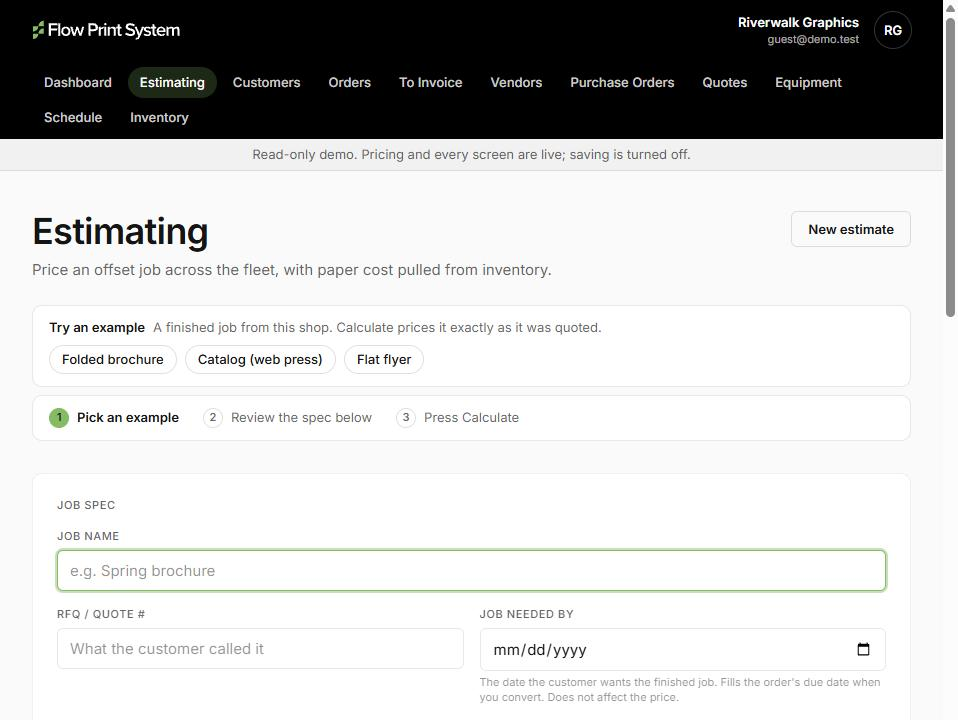
Open a working print shop and price a job.
The demo is a working shop with its own presses, paper and customers. Nobody has to show you how.
The demo is read-only: pricing and every screen are live, and saving is turned off. The shop's rates are sample numbers, not any real shop's. Yours are decoded from your own spreadsheets during onboarding.
In production at a commercial printer in the Chicago suburbs.
Web and sheetfed, three estimators writing real quotes in it since September 2026.
Estimating, quoting, orders, job tickets, packing slips, invoice preview and QuickBooks export. Paper inventory. Customer intel and dashboards. Email intake to a client-facing quote.
In-app support requests, re-pricing an order in place, a paper price list fed from the supplier, and quoting from a phone call rather than an email.
Send 10 quotes you already wrote.
We price them in the system and walk the differences with you, line by line. If the numbers do not hold up, you have lost an hour and learned something about your own pricing. If they do, you know exactly what you are buying.
Prefer email? Write to kevin@automateddataservices.com.
 Flow Print System, by Automated Data Services, LLC
Kevin Farm. Hampshire, Illinois.